Event: 20260309-014122
Hundreds of eyewitnesses in the states of Connecticut, Indiana, Maryland, Michigan, North Carolina, New Jersey, New York, Ohio, Pennsylvania, Virginia, West Virginia, the District of Columbia and the Canadian province of Ontario have filed reports on the American Meteor Society website of a bright fireball seen on the night of March 8 at 9:41 PM Eastern Daylight Time (2026 March 9, 1:41 UTC). The event was also captured by numerous meteor cameras in the region, including three belonging to the NASA Fireball Network. An analysis of the video data shows that the meteor appeared 57 miles above the Maryland town of Paw Paw, moving a bit north of west at 62,000 miles per hour. It traveled 86 miles through the upper atmosphere before disintegrating 24 miles above Point Marion in southern Pennsylvania. At its peak, the fireball was about 10 times brighter than the planet Venus.
The orbit strongly indicates that this meteor was a member of the little-known eta Virginid meteor shower. Active in March, the eta Virginids are thought to come from an as-yet-unidentified asteroid, making it one of the few meteor showers lacking a cometary parent. On March 17, 2013, NASA telescopes observed a bowling ball size eta Virginid strike the Moon, leaving behind a new crater 60 feet in diameter. The object producing this fireball was much smaller, being roughly 2 inches in diameter.
Images and Video from NASA and Western University's Southern Ontario Meteor Network
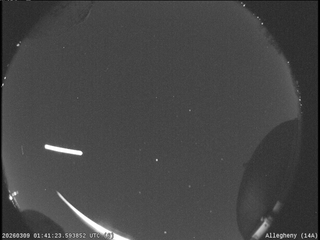
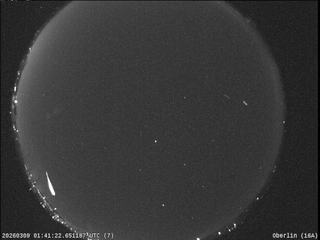
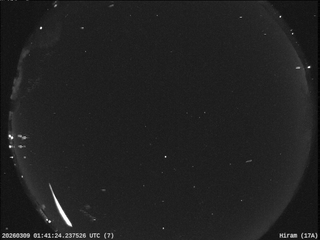
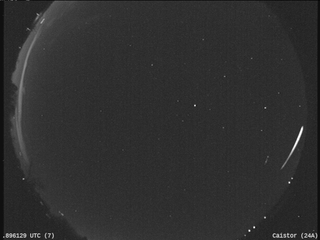
Event Data
| Event ID | 20260309-014122 |
| Date (UTC) | March 9, 2026 |
| Time (UTC) | 01:41:22 |
| AMS Event | 1563-2026 |
| Magnitude | -6.2 |
| Size | 2 inches |
| Origin | eta Virginids |
| NASA Camera Start Lat/Lon | +39.568, -78.479 |
| NASA Camera End Lat/Lon | +39.762, -79.963 |
| NASA Camera Altitude | 91.9 km → 38.4 km ( 57.1 miles→ 23.9 miles) |
| NASA Camera Speed | 27.7 km/s (62,000 mph) |